



Ground Truth Is the New AI Advantage: Why Better Models Need Real Human Data
Ground truth is a trusted reference used to train, test or judge an AI system. As more new web content is AI-generated and some reliable sources restrict crawlers, the advantage goes to organisations that find where their models fall short, validate them with the people they serve, and feed that evidence back into development.
Imagine a voice assistant that performs brilliantly in English-language testing but struggles with the way some of its actual customers speak. The benchmark looks healthy. The customer experience does not. That is a hypothetical example, but it gets to a very practical problem: an AI system can be impressive in testing and still miss the people or situations it was built to serve.
My view is that the next meaningful AI advantage will not come from producing ever more training examples. It will come from knowing where a model's understanding falls short, then collecting trustworthy evidence from the people and settings that matter. That is what good ground truth provides.
Ground truth is not just content written by humans
Ground truth is a reliable reference against which we can train, test or judge an AI system. It might be a verified outcome, an expert's assessed label, a native speaker's interpretation or an observation of how a customer actually completes a task. Sometimes it comes from people; sometimes from independently verified measurements or records.
That distinction matters. Human-generated information is not automatically correct. People disagree, remember things imperfectly and bring their own biases. Ground truth becomes useful when the evidence has been deliberately captured, checked and documented for a defined purpose. More data is not always better data.
The public web is no longer a straightforward starting point
The important change is not simply that AI writes a great deal of material online. It is that future models cannot assume another crawl of the same web will reveal the human experiences they have missed.
Graphite examined a random sample of 55,400 English-language articles in Common Crawl. Its estimate was that 49.9% of articles newly published in the first quarter of 2026 were primarily AI-generated. The share had hovered around half for five quarters, rather than continuing to climb [1]. That is an estimate for a specific category of articles, not a claim that half of the entire internet is AI-written.
Separate research using Internet Archive data reported that more AI-generated text was associated with less semantic variety - in plain English, a narrower range of meanings and ways of expressing them. The authors did not find statistically significant evidence of a fall in factual accuracy [2]. That distinction is important: a dataset can remain broadly accurate while becoming less useful for learning unusual cases.
Access is another constraint. In a study of popular websites, roughly a quarter of the top 1,000 restricted AI crawlers. Among news outlets rated as highly factual, 55% blocked OpenAI's GPTBot [3]. That does not mean every reliable source is closed. It does mean some valuable sources are less readily available to anyone relying on indiscriminate web scraping.
The people missing from the data are not edge cases to them
Language makes the problem easy to see. W3Techs reported that English appeared on 49.5% of websites for which it could identify a content language on 3 November 2026. Bengali accounted for 0.1%, while Hindi, Tamil and Swahili each appeared on fewer than 0.1% [4]. Those figures describe detectable website content, not the number of people who speak each language.
Research benchmarks point to a related concern. MuBench found persistent gaps between English and lower-resource languages across its 61-language evaluation [5]. MMLU-ProX also identified substantial differences in performance across 29 languages [6]. These are benchmark findings, not measurements of any particular company's service.
Consider, hypothetically, a bank offering an assistant in English and Bahasa Indonesia. If it tests thoroughly in English but barely tests with Indonesian-speaking customers, it has not shown that both groups receive the same standard of service. It needs people who use the language, understand the context and can reveal what a general benchmark misses.
If a language, dialect or culture is missing from your evaluation data, another generic web crawl is unlikely to solve that problem. You need evidence from the people you intend to serve.
Synthetic data is useful. The closed loop is the risk.
Synthetic data can do jobs that would be slow, costly or unsafe to reproduce with people. It can generate variations, probe potential failures and help teams practise difficult scenarios. I would not argue for abandoning it.
The risk appears when models learn repeatedly from their own outputs without a reliable connection back to external evidence. Research in Nature demonstrated that indiscriminate recursive training can lead to model collapse: over generations, models lose information about the original distribution, with rare cases disappearing first [7]. Think of an unusual accent or an uncommon complaint quietly dropping out of what the model handles well.
Later research explored how repeated retraining can reinforce existing biases [8]. A 2026 preprint also reported a 'polarisation of competence': synthetic training improved strong capabilities while weaker ones degraded in its experiments [9]. These are findings under particular experimental conditions, not proof that every use of synthetic data produces collapse.
The operational risk is straightforward. Your overall benchmark score may improve while the behaviour you have tested least gets worse. Teams need to look beyond the average.
Build a loop back to reality
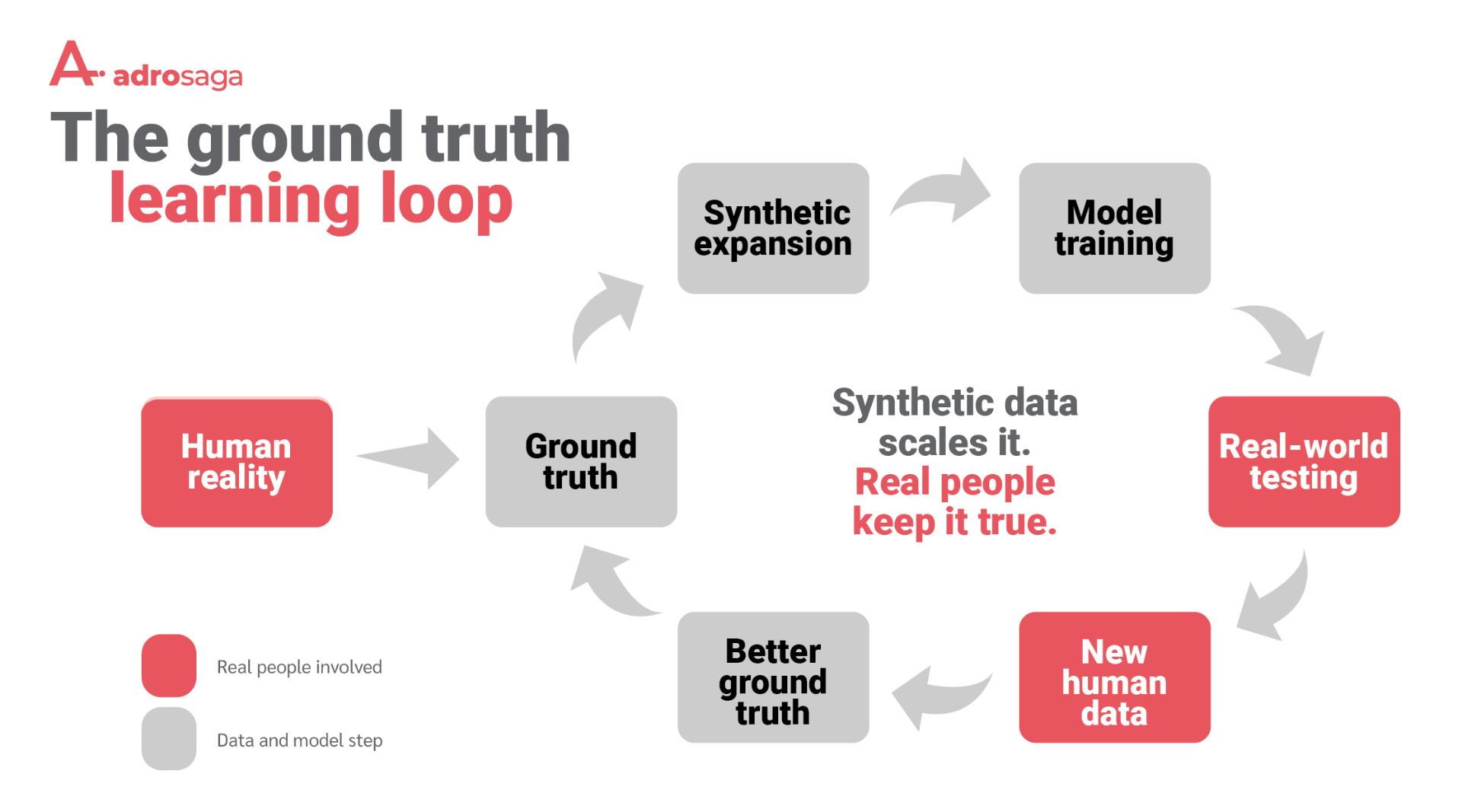
A better approach uses synthetic data and external validation together. Imagine a voice-support team noticing errors with an uncommon dialect. It might generate synthetic examples to explore the problem, test the revised model with speakers of that dialect, document the failures and feed the findings into the next round of development. Then it tests again.
That sequence is the point: identify a weakness, generate useful tests, validate with relevant people, record what happened, and improve the model. The evidence does not have to be human-supplied in every case. But where the system interacts with people, there is no substitute for testing whether it actually works for them.
Better data can be an advantage - but only if it stays useful
If several organisations use the same foundation models and much of the same public data, neither is likely to gain a lasting edge simply by collecting more of it. The more useful question is: what does our system need to understand that our existing data does not show?
The answer might involve older consumers trying a banking assistant, specialists reviewing an AI agent's work, or speakers of dialects missing from a speech model's tests. An organisation can collect evidence focused on those gaps and improve its systems from it.
Calling that dataset 'proprietary' is not enough. Competitors may be able to recruit similar participants. The defensible part is the process: obtaining the right permissions, reaching the right people, collecting consistent evidence, finding weaknesses, and repeating the work as the model and its users change. That is harder to copy than a static collection of examples.
Five questions worth asking your own teams
Which users, languages or situations matter in production but are absent from our evaluation set?
What evidence tells us that the labels and outcomes we call 'ground truth' are actually reliable?
When a test exposes a weakness, how does that finding get into the next development cycle?
Who has independently challenged the model's performance, and what did they find?
If a customer, risk committee or regulator asked how we know the system works for its intended users, what could we show them today?
If the answer to that last question is 'we would need to assemble the evidence', the gap is already visible.
Regulation makes the evidence harder to ignore
The regulatory direction adds weight to the practical argument, although the rules differ by industry and jurisdiction. These are not four versions of the same training-data obligation.
European Union — EU AI Act. For covered high-risk systems, Article 10 addresses the quality and relevance of training, validation and testing datasets; Article 14 addresses human oversight. Following the EU's AI Omnibus changes, the relevant Annex III high-risk rules apply from 2 December 2027, with a separate 2 August 2028 date for high-risk systems embedded in regulated products [10]. Applicability depends on the system and the organisation's role.
USA — SR 26-2. The banking agencies' April 2026 guidance replaced SR 11-7 for model risk management and emphasises risk-based validation and objective 'effective challenge'. It expressly excludes generative and agentic AI from its formal scope. My view is that the underlying questions about independent challenge remain sensible for organisations deploying those tools; that is a governance judgement, not a claim about the guidance's legal scope [11].
Australia — APRA CPS 230 and CPS 234. These prudential standards address operational risk, service-provider oversight and information security for entities within their scope. They are not dedicated rules on AI training-data representativeness [12, 13].
Singapore — MAS AI Risk Management Guidelines. Issued on 7 October 2026, the guidelines describe risk-proportionate expectations for financial institutions' AI governance and lifecycle controls. They begin taking effect on 7 October 2027, with some sections phased to October 2028 [14].
Different frameworks, different obligations. The question for a leadership team is much simpler: what did we test, who checked it, which users did it cover, and where is the evidence?
Why we are building Adrosaga
This is one of the reasons we are building Adrosaga. Good AI testing should not stop at an internal benchmark or a demo that works for the people who built it.
Adrosaga helps organisations recruit relevant contributors through the Adrosaga Global Crowd, capture structured data for AI training, and test deployments with people who reflect the intended users. A testing engagement can record the scenario, the participant profile, what the system did, and the result. Those findings give product, risk and compliance teams evidence they can assess and map to the requirements that apply to them. Adrosaga supplies the testing and evidence; the client's own teams remain responsible for their regulatory decisions and filings.
The advantage is staying connected to reality
AI can generate an extraordinary volume of examples. What it cannot do by itself is establish whether those examples reflect the experiences, language and decisions of the people who will rely on the system.
The organisations that keep checking their models against trustworthy external evidence will be better placed to see weak spots, improve performance and explain their decisions. To me, that is the real value of ground truth.
Click here to find out where your AI hasn’t been tested.
— Ollie Woodman
Head of AI, Adrosaga
AI-assisted. Human-authorised.
Frequently asked questions
What is ground truth in AI?
Ground truth is a trusted reference used to train, evaluate or validate an AI system. It can come from verified outcomes, expert assessments, measurements or carefully checked human observations.
Why does AI need input from people?
For systems used by people, human testing reveals language, behaviours and expectations that standard datasets may miss. The input still needs appropriate checks; being human-generated does not automatically make it correct.
Is synthetic training data a problem?
Not inherently. It can broaden tests and speed up development. The risk is relying on model-generated data repeatedly without checking performance against reliable external evidence.
What is model collapse?
It is a loss of information about the original data distribution that can emerge during repeated training on model-generated outputs. Rare or weakly represented cases can disappear first.
Why can AI perform differently across languages?
Training and testing coverage varies by language, dialect and context. Strong results in a widely represented language do not establish equivalent quality for every other audience.
Do AI regulations require human-validated training data?
Requirements depend on the system and jurisdiction. Some rules address dataset quality and oversight directly; others focus on model risk, operations or governance. Human testing can provide useful evidence, but it is not a universal legal requirement for every AI system.
Citations
[1] Graphite — AI Now Writes as Many Online Articles as Humans (May 2026)
[2] Dolezal et al. — The Impact of AI-Generated Text on the Internet (April 2026; preprint)
[4] W3Techs — Usage Statistics of Content Languages for Websites (figures dated 3 November 2026)
[10] European Commission — EU AI Act implementation and high-risk rules
[11] Federal Reserve — SR 26-2, Revised Guidance on Model Risk Management (17 April 2026)
[12] APRA — CPS 230, Operational Risk Management
Please share if you find this interesting


Related News

Our Contributors Are Not a Resource. They Are Our Advantage.

Adrosaga treats contributor experience as a primary driver of AI data quality. Contributors who get clear tasks, fair and prompt pay, accessible support and fair quality review…

Singapore FinTech Festival 2026 and the MAS AI Guidelines: Can You Show Your AI Works for Customers?
The MAS Guidelines on Artificial Intelligence Risk Management, issued on 7 October 2026, take effect for MAS-regulated financial institutions on 7 October 2027, with life cycle…

The AI Trust Gap Is Now the Real Barrier to Deployment

AI is moving fast. Trust is not. Christian Bates, Head of Sales (ANZ/NZ), on why organisations need human-validated evidence before their AI reaches real customers, and what that…